

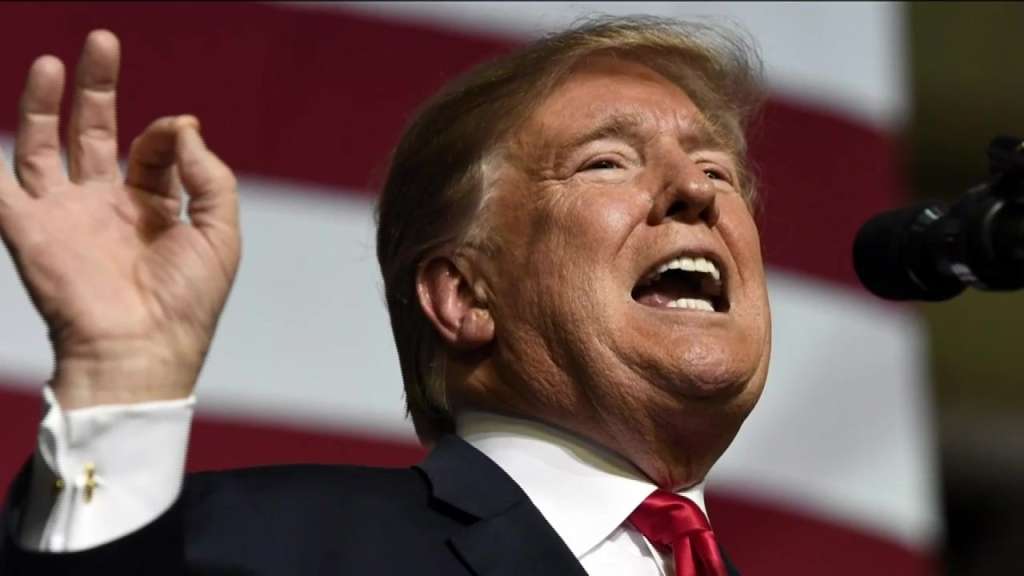
WASHINGTON (AP) — President Donald Trump reacted Wednesday to Republicans’ midterm election losses by showing off the White House ballroom he’s building as he demonstrated the kind of detached behavior that voters around the country said was a key reason they opted to punish his party.
In an extraordinary scene, Trump summoned reporters to the hulking construction site that he demolished the East Wing to make room for and the Republican president spoke for nearly 20 minutes about minute building details. He did not mention his party losing control of Congress after defeats in some of the country’s deepest GOP strongholds, including Texas and South Carolina, or voter concerns about the high cost of living and federal corruption that helped cause the election losses.
“This has been a structure the likes of which has never been seen anywhere,” Trump said, speaking into a microphone that sent loud feedback echoing around the cavernous space.
He talked at length about how the ballroom would be the ”safest place in Washington” upon completion, stretching five stories underground and featuring a cut of marble that he called “a vein that people have been after for 50 years.”
“We have large staircases coming from the kitchen. If I put the kitchen on top, you would lose three walls, because a kitchen takes about 30% of the space,” Trump said of his choice to make the ballroom’s kitchen subterranean.
“It’s going to be top of the line,” he added.
This is not what presidents normally talk about the day after an election
Presidents usually speak with reporters the day after the midterms. It’s normal for those whose party endured big losses to shoulder publicly at least part of the responsibility.
But not Trump.
He began the day with a schedule that showed only private meetings, then suggested he had decided at the last minute to invite the press to watch as the final steel beam — topped with a small evergreen tree symbolizing growth and luck — was hoisted into place on the ballroom roof.
Trump signed the beam with a marker during the ceremony, writing “Love!” followed by his name in supersize letters.
His appearance came after midterm voters said they thought the president was focused on the wrong issues. About two-thirds of voters said Trump does not have the right priorities, according to The AP Voter Poll, and the overwhelming majority of these voters supported Democratic House candidates.
The post-midterm ceremony might also reinforce voter concerns about whether Trump, 80, is up for the rigors of the presidency.
Biden dropped out of his reelection race in 2024 after a disastrous debate with Trump, who even today frequently mocks Biden’s mental and physical acuity.
Trump seeks to shift blame for the midterms
Trump eventually took questions at the ballroom site and attempted to duck responsibility for the broad Republican losses. He insisted he didn’t lead the party into an Election Day drubbing despite staging a flurry of rallies where he implored supporters to pretend that he was on the ballot.
“If I were on the ballot I would have won,” Trump insisted.
He said campaign rallies in mostly Republican states or conservative parts of more closely divided ones featured enthusiastic crowds “but we weren’t able to transfer love to the candidates.”
The beam-raising was not his first baffling political moment this week. On Monday, Trump gave his closing message of the midterm cycle in a long speech at the Lincoln Memorial Reflecting Pool, shining a spotlight at a pivotal time on a project marred by algae, leaks and delays.
“I heard it was a very good speech, got great reviews,” he said on Wednesday.
Ducking responsibility is common with Trump
An Associated Press analysis of the 39 Trump speeches and rallies that Trump staged between Sept. 1 and Election Day showed the president used phrasing suggesting he was on the ballot in 30 of them. In some addresses he returned to the subject more than once, though, meaning there were at least 40 instances where he appealed to voters to engage in that bit of make-believe.
But as the extent of his party’s defeat became apparent on election night, Trump was deflecting blame.
“I don’t like to consider it a defeat for me. I wasn’t on the ballot,” he told Fox News Channel. Voters, he said, just “didn’t like the candidates” on the ballot. The Voter Poll suggests Trump himself was a drag on GOP politicians and that in some races, candidates were seen as too supportive of the unpopular president.
Trump has a long history of passing the buck, on issues large and small, especially when there are ballot-box failures.
After Republicans lost the House in the 2018 midterms during Trump’s first term, he blamed defeated members of his own party.
Utah Rep. Mia Love, who had tried to distance herself from him, “gave me no love, but then she lost. Too bad,” the president said, while also mocking other losing lawmakers for not embracing him — Florida’s Carlos Curbelo, Colorado’s Mike Coffman, Virginia’s Barbara Comstock, and Illinois’ Peter Roskam.
That’s in contrast to how Democrat Barack Obama described his party’s losses in 2010 as “a shellacking” or Republican George W. Bush described Democratic victories in the 2006 midterms as “a thumping.”
But Trump, known for defying all kinds of presidential norms, began laying the groundwork for avoiding blame this cycle well before balloting began.
He told Punchbowl News in August that voters were angry at Republicans “but they’re not angry at me.”
The president posted on his social media site last month that should Texas Republican Senate candidate Ken Paxton lose — and he did — “it will be because of WEAK and INEFFECTIVE Political Hacks like John Cornyn and Karl Rove.” That’s despite Trump’s risky endorsement of scandal-marred Paxton in the primary over incumbent Cornyn, who first got to the Senate in 2002 and was considered the safer bet. Rove is a political strategist who helped Bush win the White House.
Also losing Tuesday was Texas Gov. Greg Abbott, a longtime Trump ally.
Trump posted on social media that if Abbott “hadn’t become a RINO in the last six months of his Political Life, he wouldn’t have lost,” suggesting the governor had backed away from his staunchly conservative credentials and become “Republican in Name Only.”
(Copyright (c) 2026 The Associated Press. All Rights Reserved. This material may not be published, broadcast, rewritten, or redistributed.)