

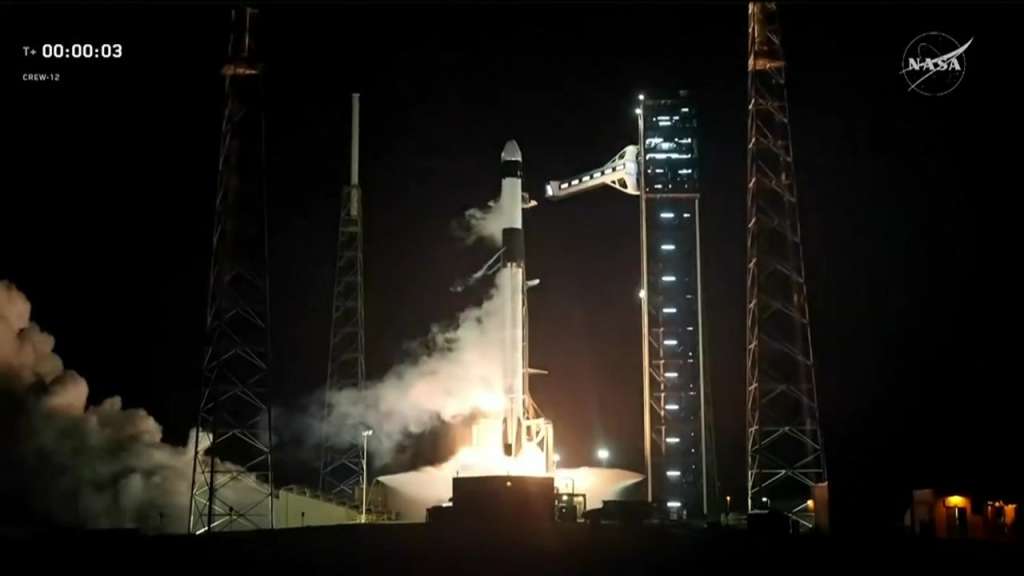
Elon Musk’s rocket company SpaceX will make its debut on Wall Street Friday and both institutional and retail investors are expected to gobble up the 555.6 million shares going up for sale at $135 apiece. Musk, already the world’s richest man, could become its first trillionaire.
SpaceX is likely to become the biggest IPO ever, with proceeds of around $75 billion. SpaceX hopes to become the first company to send people to Mars. In fact, part of Musk’s future compensation depends on SpaceX eventually establishing a colony of at least 1 million people on the red planet.
Why SpaceX is going public now
In a video conference on Musk’s social media platform X, he told JPMorgan CEO Jamie Dimon that people have suggested for the last 10 years that he take SpaceX public. He’s doing it now because the company plans to put 100,000 next-generation Starlink satellites into orbit. Deploying AI data centers in space is a “massive new growth base and you need capital for that,” he said.
Going public provides access to the capital that SpaceX needs. But it also exposes it to more scrutiny from shareholders and more regulatory oversight. That includes filing quarterly financial reports, which critics say incentivizes short-term thinking over longer-term planning and creates unnecessary costs for a company. Securities regulators are currently soliciting public comment on a proposal to require public companies to file the financial reports only twice every year.
How the IPO impacts the company
Musk will hold the majority of a special class of shares, giving him control over decisions related to company strategy, finances and personnel. On the latter, because of his ownership of most of these Class B shares, the only person who can fire Musk as CEO … is Musk.
The company credits Musk with being the “driving force” behind its growth, innovation and success. But what happens if Musk is no longer in the picture? SpaceX warns that the loss of Musk could disrupt its ability to execute its strategy as well as hurt its “reputation and relationships with customers, partners and other stakeholders.”
The company also warns that finding a replacement with the same skills and experience as Musk would be time-consuming, if not nearly impossible. As Wedbush Securities analyst Dan Ives wrote Wednesday, “At the end of the day Musk is SpaceX and SpaceX is Musk.”
Some big investors are unhappy. Officials from pension funds for firefighters, teachers and other workers in California and New York sent a letter to SpaceX last month decrying some of the provisions in its IPO, including the “super voting shares,” mandatory arbitration of shareholder claims instead of the possibility of lawsuits and how much power Musk will hold over the company.
They said they could become owners of SpaceX stock because they hold index funds, which automatically buy stocks after they get included in certain indexes.
What could make or break SpaceX
Currently in the test phase, the gigantic reusable Starship rocket is key to SpaceX realizing Musk’s ambitions. Much of the commercial space business hinges on SpaceX developing Starship’s capability to be fully reusable and hearty enough for a quick turnaround between flights. If that doesn’t happen, SpaceX warns that putting data centers and satellites in space will take longer and cost more money, meaning it risks customers bailing on the company.
Analysts say that by pioneering reusable rockets, SpaceX has established a clear lead on competitors such as Blue Origin, led by Amazon founder Jeff Bezos. The Starlink satellite business competes with, among others, AST SpaceMobile – which is relying on a SpaceX rocket to send its latest generation of satellites into orbit next week.
The prospectus filed last week says SpaceX’s biggest potential market is the sale of business-oriented artificial intelligence products designed to transform how people get work done. It’s an opportunity SpaceX predicts would be worth $22.7 trillion if it could somehow dominate rivals like Anthropic, OpenAI and Microsoft in a highly competitive industry. But the prospectus shows no clear path to profitability for the xAI business, which merged with SpaceX earlier this year.
Why Wall Street is paying attention
If the SpaceX IPO is as successful, the stock could quickly join the Nasdaq 100, a widely followed index that tracks the 100 largest non-financial companies in the composite. That’s important because some popular funds, such as the $460 billion QQQ exchange-traded fund, mimic the index and will automatically buy whatever is listed in the index.
Nasdaq recently changed its rules to allow select companies to enter the Nasdaq 100 after just 15 trading days.
S&P Dow Jones Indices, on the other hand, is sticking to established and more traditional thresholds that will not allow SpaceX or other companies with gargantuan IPOs faster entry into its S&P 500 index. That means even high-profile companies will still need to wait for their stocks to trade a full 12 months before they can enter the index.
Companies want to be in the S&P 500 in particular because it’s arguably the most important index on Wall Street, with trillions of dollars either mimicking it exactly or benchmarked against it. Vanguard’s VOO fund that tracks the S&P 500 has roughly $950 billion invested in it, for example.
(Copyright (c) 2026 The Associated Press. All Rights Reserved. This material may not be published, broadcast, rewritten, or redistributed.)