

NUWAKOT, Nepal (AP) — Most arrive with nothing except the clothes they are wearing.
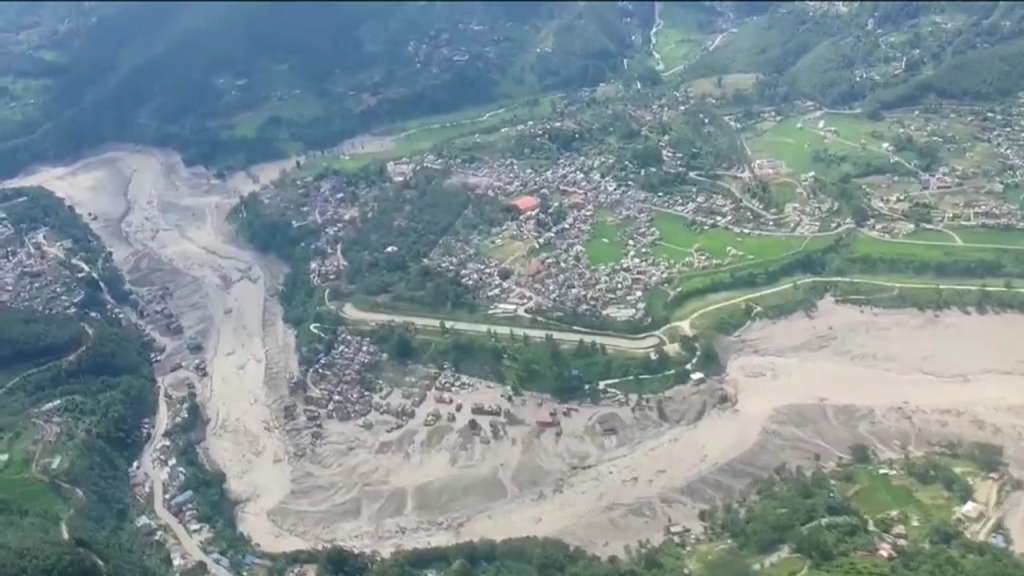
As rescue efforts in communities buried by catastrophic flash floods along the border between Nepal and China entered their fourth day Saturday, authorities continued finding survivors and transporting them to safety. At relief centers, as some arrive, families wait anxiously for news of their loved ones as the death toll and the number of people unaccounted for continued to rise.
After Nepali authorities updated their figures Saturday, the combined toll in Nepal and Tibet rose to 676 dead and nearly 3,000 people missing. Chinese authorities have reported seven deaths and more than 550 missing.
In Nuwakot, one of the Nepali districts devastated by the floods, helicopters resumed operations before noon Saturday after poor weather temporarily hampered aerial rescue activities.
Some helicopters were loaded with boxes and bags of aid, including clothes, instant noodles, crackers and rice. Others returned from the flood-hit areas carrying survivors.
An older man was carefully helped off one helicopter, while a soldier carried an older woman on his back to a medical tent. There, medics checked her blood pressure, breathing and heartbeat, as well as her teeth and gums.
About a dozen people emerged from another helicopter. Soldiers carried several babies who had been evacuated.
The evacuees had been brought from the nearby community of Trishuli.
Villagers return to devastated homes
As people were still leaving Trishuli, some village residents were returning to see what could be salvaged from their decimated homes.
One boy walked out of the village carrying muddy sandals from his house. Another woman, Shoba Shretha, returned to find her dog, Sweetie, who she was forced to leave behind when the floods came. Shretha sat on the ground petting her and feeding her water from a bottle.
At some point, relief coordinators cleared villagers, reporters and volunteers from the entrance to Trishuli, as excavation equipment drove into the flooded village to dig.
Families begin to lose hope
In Kathmandu, Nepal’s capital, relatives and friends gathered outside the main government hospital from early morning, desperately searching for news of missing loved ones.
Many shuffled between the help desk and the hospital notice board, clutching photographs and scanning injured patients’ lists in the hope of finding them.
Dil Maya Lama stood weeping outside the help desk at the hospital, searching for information about her missing 26-year-old brother, a driver for a hydropower company in Rasuwa. She had traveled from Ramechhap, about 130 kilometers (80 miles) away.
“I came here with the hope that I might find him,” she said. “There is no information about him.”
Nelza Moktan anxiously sought information about her missing cousin, who also worked as a driver in Rasuwa.
“I feel hopeless. It has already been four days,” she said.
Families covered hospital walls with posters showing missing relatives, photographs and contact numbers in a desperate appeal for any clue that could bring them home.
Nearby were photographs of unidentified bodies which officials put up in hopes they could be recognized by families or friends.
Gajendra Rawat, a security official at the hospital help desk, said families had so far registered around 1,600 missing persons since the disaster struck. “People are coming from all parts of Nepal,” he said.
Families search paper lists for any clue
Back in Nuwakot, military personnel taped sheets of paper listing dozens of missing people to a wall at a relief center, prompting families to crowd around them.
Some scanned lists of the missing and dead, took photos and wiped away tears as they looked through the names.
Rajesh Kumar Ram, who is searching for his son, desperately searched a list for his son’s name.
“I’m hopeful, by chance, that my son is somewhere,” he said, crying as he spoke. “Maybe they find him stuck somewhere. I’m waiting for that moment only.”
Outside, people walked along mud-covered streets past signs of the disaster. On one street, a truck was stuck in the mud with its bed raised in the air.
As the day passed, more people gathered at the army barracks hoping to be reunited with missing loved ones or to find out information about them.
Priti Kharel stood outside the entrance to the barracks, holding a poster with a picture of her brother, Milan Kharel, who works as an engineering geologist at Doosan Enerbility. His family hasn’t heard from him since the floods.
“It’s already four days,” said Kharel, who believes his brother could be one of the people trapped inside the tunnel of a hydropower construction site, where authorities have rescued some people. She said friends who were there told the family that Milan might still be there.
“We want the government to rescue him as soon as possible,” she added.
Rescuers battle to find survivors in disaster-hit areas
Search and rescue efforts continued at several locations in Nepal and China’s Tibet, including the Upper Trishuli-1 Hydropower Project in Nepal’s Rasuwa district and the severely damaged Gyirong border crossing on the Chinese side.
Nepali Army spokesperson Brig. Gen. Raja Ram Basnet said rescue efforts would continue at the hydropower construction site, where authorities believe more than 100 people are trapped in a tunnel filled with thick mud.
Basnet said rescuers had used baskets and ropes to reach some people, but the operation remained difficult because of 4 to 5 feet (1.2 to 1.5 meters) of mud and the limited number of places where helicopters could land.
He said rescue teams had also been forced to relocate temporarily when authorities issued warnings about possible further flooding.
Rescuers have been on high alert for more flooding from a new lake that formed high up in the Himalayan mountains after the initial floods Wednesday. Experts warned that the lake, created after a glacier collapse that triggered the floods, was starting to overflow.
Monitoring data from the Chinese Ministry of Water Resources showed late Friday that the lake had dwindled in size. The water level dropped by 10 meters (32 feet) from the high point on Thursday morning, Chinese broadcaster CCTV said.
Aid trucks could be seen traveling from Kathmandu, Nepal’s capital, toward the affected areas.
Search continues at devastated China-Nepal border crossing
The Chinese broadcaster showed images Saturday of rescuers arriving at Gyirong Port, the hard-hit border crossing with Nepal. Some reached the area by foot or via rafts, while others dropped down from drones flown to the area. “Anyone, anyone?” rescuers yelled.
It was not immediately known how many people were at the border checkpoint building when the floods hit.
On Saturday, Nepal’s disaster agency said the death toll had climbed to 669 with 2,426 people missing in the country. More than 3,700 people have been rescued in Nepal so far.
The death toll in China rose to seven Friday as state media showed evacuations of villages and leaders’ efforts to direct the relief response. China’s state media said 554 people were missing on the Chinese side. Hundreds of the missing are foreigners who were in the area to work, trek or make a pilgrimage to a sacred peak.
Steep mountains and narrow gorges hamper rescue operations
In a news briefing Saturday, Nepalese Foreign Minister Shisir Khanal said authorities have mobilized all available resources with support from international assistance for search, rescue, relief and recovery operations, with a particular focus on locating those still missing.
“This is currently our national priority,” he told reporters Saturday.
He said rescue operations are challenging because of steep, tall mountains and narrow gorges in the disaster-hit region.
Khanal said the government has sought specialized support from Nepal’s neighbors in tunnel rescue, survivor-detection technology, rapid forensic and DNA analysis, as well as morgue refrigerators.
An 11-member tunnel rescue reconnaissance team from India has been deployed while a similar rescue team from China is expected shortly, he added.
The minister said Nepal has received over 57 metric tons of relief supplies from India, with additional aid arriving from China, Japan, Australia and other countries. He added that further support will be sought as need assessments continue.
Despite severe flood damage in four districts, the rest of Nepal remains open and fully accessible to visitors, Khanal said. “We welcome foreign nationals willing to visit Nepal,” he said.
___
Kafle reported from Kathmandu, Nepal. Associated Press journalists Eileen Ng in Kuala Lumpur, Malaysia; Sibi Arasu in Bengaluru, India; Upendra Mansingh in Nuwakot district, Nepal; Aijaz Hussain in New Delhi, India; and Didi Tang in Washington contributed to this report.
——-
The Associated Press’ climate and environmental coverage receives financial support from multiple private foundations. AP is solely responsible for all content. Find AP’s standards for working with philanthropies, a list of supporters and funded coverage areas at AP.org.
(Copyright (c) 2026 The Associated Press. All Rights Reserved. This material may not be published, broadcast, rewritten, or redistributed.)