

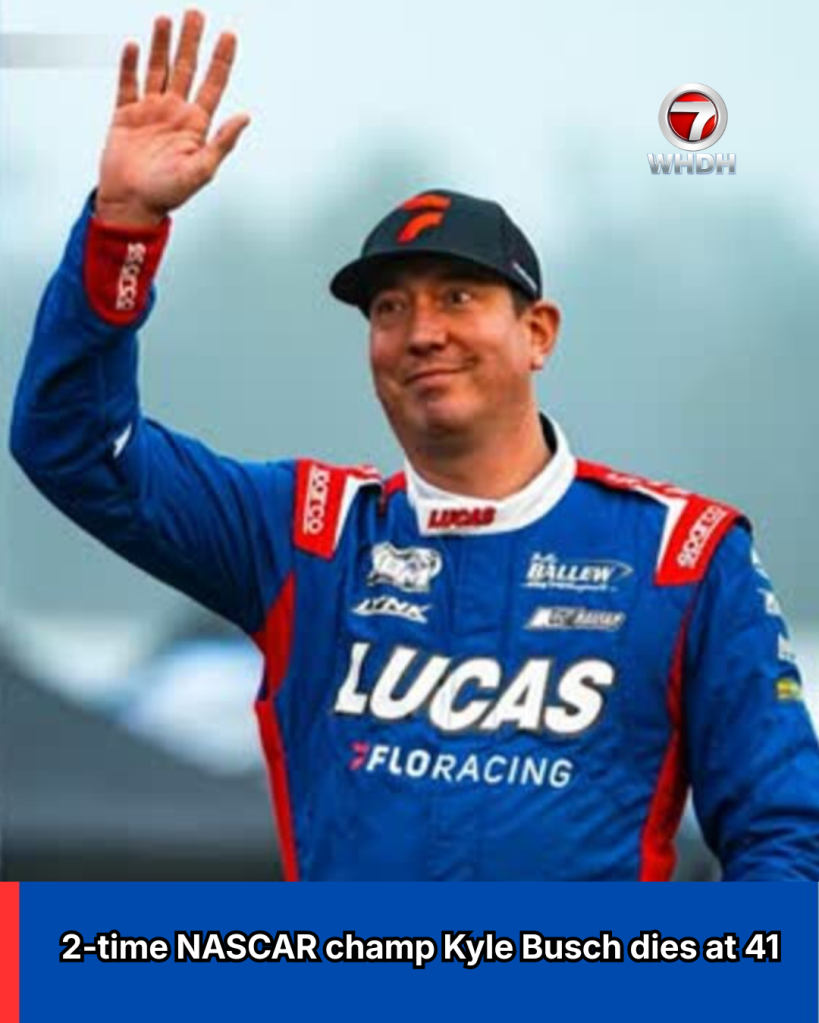
CONCORD, N.C. (AP) — Kyle Busch died after severe pneumonia progressed into sepsis, resulting in rapid and overwhelming complications, according to a statement released by his family.
Dakota Hunter, vice president of Kyle Busch Companies, said in a news release the family received the medical evaluation on Saturday.
Busch, a two-time NASCAR champion, died at 41 on Thursday, a day after passing out in a Chevrolet simulator.
Sepsis is considered a life-threatening medical emergency that occurs when the body has an extreme, overactive response to an infection, causing the immune system to damage its own tissues and organs, according to the Centers for Disease Control and Prevention.
Typically the immune system releases chemicals to fight off pathogens like bacteria, viruses or fungi, but with sepsis the response goes into overdrive. The results can cause widespread inflammation, form microscopic blood clots and make blood vessels leak.
Busch was thought to have had a sinus cold while racing at Watkins Glen on May 10 and radioed in to his team saying that he needed a “shot” from a doctor after the race. However, he bounced back to win the Trucks Series race at Dover last weekend, and then he finished 17th in the All-Star race on Sunday.
Busch, who was preparing to race Sunday at the Coca-Cola 600 at Charlotte Motor Speedway, was testing in the Chevrolet racing simulator in Concord on Wednesday when he became unresponsive and was transported to a hospital in Charlotte, several people familiar with the situation told The Associated Press.
During the emergency call placed late that afternoon, an unidentified caller calmly told the dispatch: “I’ve got an individual that’s (got) shortness of breath, very hot, thinks he’s going to pass out, and is producing a little bit of blood, coughing up some blood.”
The caller said Busch was lying on the bathroom floor inside the complex and told dispatch “he is awake,” according to audio provided by the Cabarrus County Sheriff’s Office. The man then gave directions on where emergency responders should go and asked that they turn off any sirens upon arrival.
NASCAR driver Brad Keselowski said he knew Busch wasn’t feeling well recently.
“Yes, but I won’t go into any specifics,” Keselowski said. “But then when he ran the Trucks race last week, those (thoughts) were honestly kind of erased in my mind.”
Keselowski said running multiple races on the same weekend can be difficult on a driver’s health — but most don’t want to miss a race for fear of being replaced.
“There’s no shortage of drivers that would love to take my seat or anybody else’s seat if we weren’t feeling well, and I think every driver feels that pressure,” Keselowski said. “All athletes do. It’s not unique to NASCAR in that sense. We’re all thinking to ourselves, ‘I don’t wanna be replaced.’ … So you try to power through it the best you can.”
Keselowski said Busch’s unexpected death has forced him to pay attention to his own health moving forward.
Chase Briscoe said Busch’s health issues served as a “wake-up call” for him and other drivers, who often put aside dealing with potential issues because they are so busy traveling around the country and competing on a weekly basis.
He said if something feels off, “you need to get checked out.”
Busch’s Richard Childress Racing teammate Austin Dillon was not made available for comment.
Austin Hill will replace Busch on Sunday and drive the No. 33 car. RCR is temporarily retiring Busch’s No. 8 until his 11-year-old son Brexton is old enough to race.
All 39 cars in the field for Sunday’s race will include a small black No. 8 decal to honor Busch.
Busch won 234 races across NASCAR’s top three series over his two-decade career, more than any driver in history.
Drivers spoke at length on Saturday about his accomplishments, praising his toughness, competitive spirit and penchant for speaking his mind — all of which led to him earning a reputation as NASCAR’s villain.
“He was a polarizing figure that no matter if you like him or disliked him as a racer, he was always talked about,” Ryan Blaney said. “Just this guy that was always there and won too much, which is why people didn’t like him. And he always spoke his mind. I think people came to respect that about him, that he was true to who he was and that never changed.”
Blaney added that Busch’s personality outside of the car and his competitiveness behind the wheel made him “a larger-than-life person in racing.”
___
AP auto racing: https://apnews.com/hub/auto-racing
(Copyright (c) 2026 The Associated Press. All Rights Reserved. This material may not be published, broadcast, rewritten, or redistributed.)